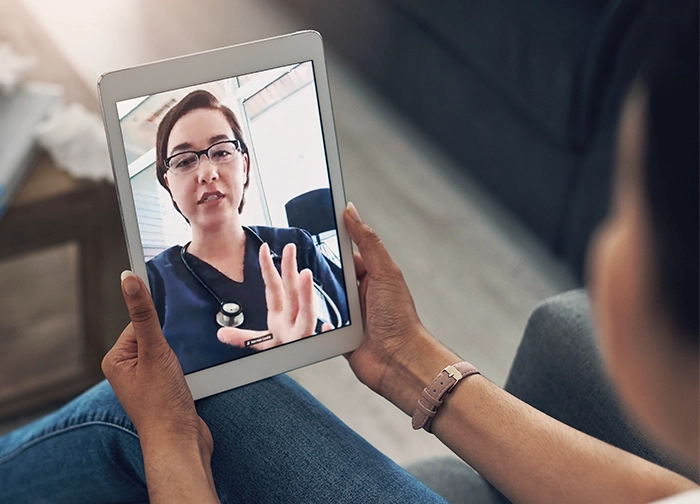
What is Telepsychiatry?
The situation
The challenge
Improve patient outcomes. Increase access to care. Lower costs.
Economics, geography, and the persistent stigma around seeking help are some of the most cited barriers to accessing mental health services.
Mental illnesses are among the most common health conditions in the United States. According to the U.S. Centers for Disease Control and Prevention, 20% of American adults will experience a mental illness in a given year, with more than half of Americans experiencing a mental illness at some point in their lifetime.
The National Institute of Mental Health states that in 2017, only 42.6% of the 46.6 million adults with any mental illness received services in the previous year.
Despite popular narratives about overdiagnosis and overmedication, these figures show that too few people are being treated for their illnesses.
Solving challenges with telepsychiatry
To offer these telepsychiatry services, community clinics, and large health systems partner with Iris Telehealth to receive highly qualified and compassionate providers who are licensed and credentialed in the state where the patient resides.
An Iris Telehealth psychiatrist or psychiatric NP provides care to your organization’s clients either during scheduled times in the outpatient setting or as needed in the hospital setting. You receive 24/7 on-call services, and your patients can receive care right away.
Our team consults with your organization to set up HIPAA-compliant technology or integrate with any pre-existing system you have. We use enterprise-grade telemedicine equipment and other state-of-the-art tools. Our systems boast a 99.9% uptime rate, and technicians are always available if you need troubleshooting advice.
A telepsychiatry session is identical to that of a conventional in-person interview. Doctors work with patients to identify issues, develop a treatment plan, and can prescribe medication.
The Iris Telehealth team includes board-certified psychiatrists in adult, child and adolescent, geriatric, and other specialty areas of psychiatry. We’ll work with your team to match your organization with the right remote psychiatrist.
Each state has its own rules, regulations, and restrictions to providing care through telehealth. We stay up to date on all these policies and advise you on compliance with all federal and state rules on telemedicine.
You can count on our help to code and capture services and remain compliant with groups like Medicare, Medicaid, and The Joint Commission.
How effective is telepsychiatry?
The efficacy of telepsychiatry has been researched and measured in the areas of feasibility, satisfaction, costs, and clinical outcomes.
Iris Telehealth ensures positive outcomes by:
- Hiring compassionate providers with personalities that shine through the video medium.
- Finding the best match for each provider and organization based on our precise understanding of preferred schedules, practice philosophy, and personality.
- Optimizing technology for patient experience, provider ease, and reliable administrative workflows.
Based on surveys and interviews with over 50 of our current partners, feasibility, satisfaction, and clinical outcomes were reported as outstanding.
An increasing amount of evidence points to the value of telepsychiatry services in many settings.
- In emergency departments, it may reduce the cost of transportation, inpatient utilization, and overall hospital costs.
- Within primary care and specialty clinics, the use of telepsychiatry services has shown to benefit patients’ overall health status and create significant cost savings.
- In community health centers, patient wait-times went from 3 months to 2 weeks.